After years of experimentation and countless projects across different domains, I’ve refined a technology stack that has become my Swiss Army knife for building modern web applications. This architecture is the result of learning from successes, failures, and the unique challenges of real-world projects.
Why This Stack?
Working on diverse projects taught me that every application has common needs: real-time data visualization, geospatial capabilities, complex data processing, and reliable performance under pressure. Rather than reinventing the wheel each time, I’ve crafted a stack that addresses these requirements elegantly and efficiently.
The Architecture
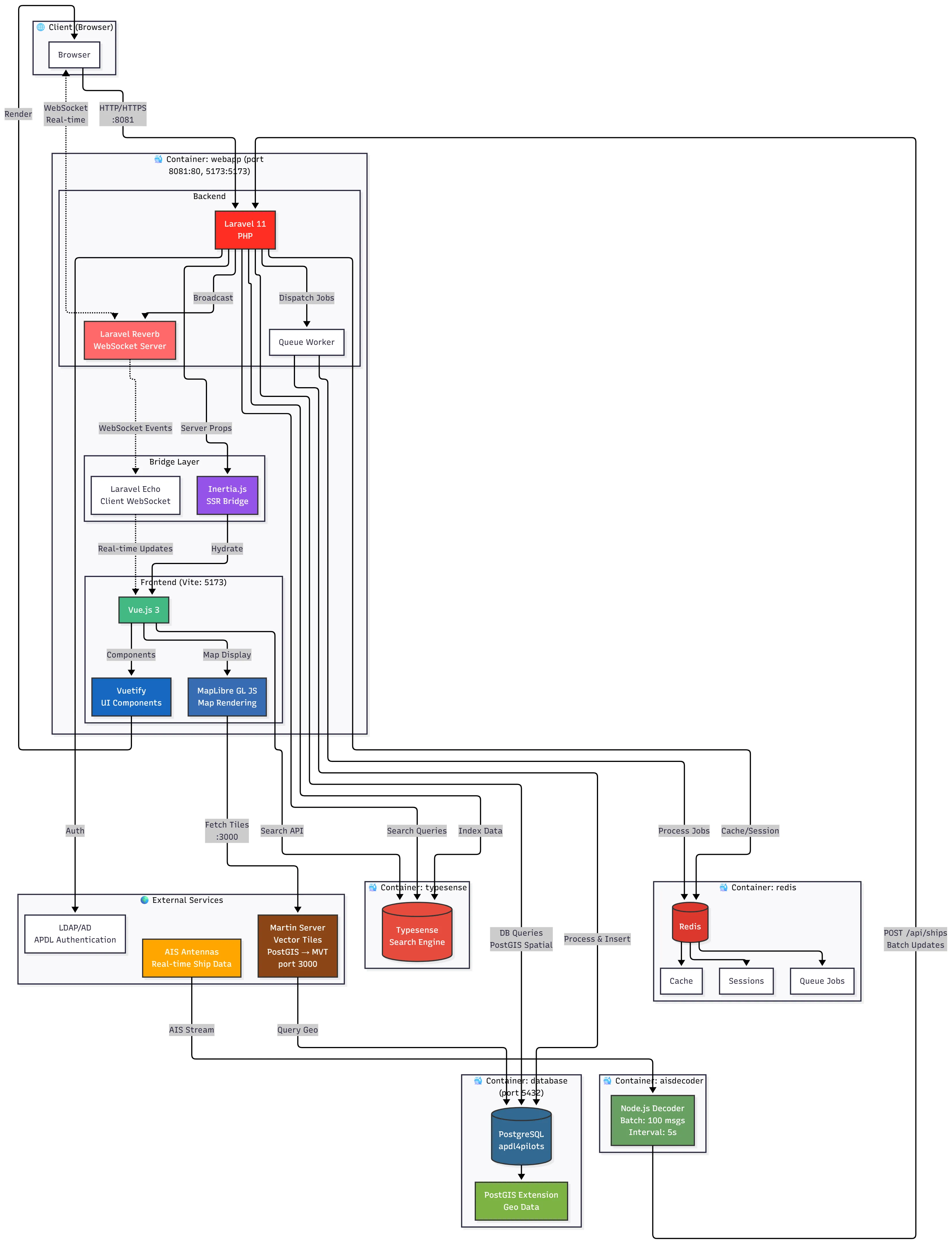
Core Components
Backend: Laravel 11
Laravel serves as the backbone, handling authentication (including LDAP/AD integration), API endpoints, job queuing, and business logic. Its elegant syntax and robust ecosystem make it perfect for rapid development without sacrificing quality.
Real-time Layer: Laravel Reverb + Echo
For port operations, real-time updates are crucial. Laravel Reverb provides WebSocket capabilities, while Laravel Echo handles client-side subscriptions. Ship movements, berth statuses, and alerts flow seamlessly to users.
Frontend: Vue 3 + Inertia.js
Inertia.js bridges Laravel and Vue without the complexity of a full SPA API. It’s the perfect middle ground — server-side routing with client-side interactivity. Vuetify provides polished Material Design components out of the box.
Geospatial: PostgreSQL + PostGIS + MapLibre
The heart of any port management system is its mapping capabilities. PostgreSQL with PostGIS handles complex spatial queries, while Martin serves vector tiles efficiently. MapLibre renders beautiful, interactive maps in the browser.
Performance: Redis + Typesense
Redis manages caching, sessions, and job queues. Typesense provides lightning-fast search capabilities — essential when operators need to find vessels, cargo, or documents instantly.
Containerization: Docker
Everything runs in Docker containers, ensuring consistency across development, staging, and production environments.
Real-World Example: AIS Integration
The diagram shows a practical example — integrating AIS (Automatic Identification System) data. AIS antennas capture ship broadcasts, a Node.js decoder batches messages, and Laravel processes them asynchronously. Users see ship positions update in real-time on the map.
Why It Works
This stack has evolved through practical experience. Each component was chosen to solve real problems:
- Speed: Rapid prototyping and deployment
- Reliability: Battle-tested technologies
- Scalability: Handles everything from small applications to complex enterprise systems
- Maintainability: Clear architecture makes updates straightforward
- Integration: Easy to connect with existing systems (LDAP, legacy databases, external APIs)
The Swiss Army Knife Analogy
Like a Swiss Army knife, this stack has a tool for every common scenario. Need real-time tracking? WebSockets are ready. Complex spatial queries? PostGIS has you covered. Search functionality? Typesense is blazing fast. Authentication with corporate AD? LDAP integration is built in.
More importantly, these tools work together seamlessly. I can focus on solving business problems rather than fighting with infrastructure.
Conclusion
After years of refinement, this architecture has become my go-to foundation for building web applications. It’s not about using the newest or trendiest technologies — it’s about having a reliable, proven stack that lets me deliver value quickly and confidently.
Every project teaches me something new, and the stack continues to evolve. But the core principles remain: choose technologies that work well together, prioritize developer experience, and always keep the end users — those making critical decisions — in mind.